
Universal Design for Learning: Making Materials Work for Everyone
In every classroom, children come with different stories, strengths, and ways of learning. Some grasp ideas best through words, others through images, sound, or movement. Yet for too long, teaching has often been designed with a single “typical” learner in mind. This approach can leave many students behind, from those with learning differences to those who are simply wired to learn in other ways.
Universal Design for Learning (UDL) offers a fresh perspective. It is a framework that helps teachers design lessons and materials that work for everyone right from the start. By providing multiple ways for students to access information, stay engaged, and express what they know, UDL ensures that every child has a fair chance to succeed (Brand & Dalton, 2012; King-Sears, 2014).
What Is Universal Design for Learning?
UDL was inspired by architecture. Just as buildings can be designed to include ramps and wide doorways so everyone can use them without special modifications, UDL encourages teachers to design learning experiences that are accessible from the beginning. Rather than making adjustments after realizing a student is struggling, UDL invites educators to plan ahead, anticipating the diversity of learners in every classroom (Pisha & Coyne, 2001).
This approach is especially powerful because it supports not only students with disabilities, but also those from different cultural and linguistic backgrounds. It recognizes that every learner benefits from flexibility and choice (King-Sears, 2014).
How UDL Works
At its core, UDL is about flexibility. It is built on three main principles:
- Multiple means of representation: offering information in different ways. A reading lesson might include text, audio, and images to support comprehension.
- Multiple means of engagement: motivating students through choices and real-world connections. A science lesson could include hands-on experiments, videos, or discussions.
- Multiple means of expression: allowing students to show what they’ve learned in ways that suit their strengths, such as writing, drawing, speaking, or using technology.
These principles give teachers a structure for designing lessons that respect individual differences. They also reduce frustration and help all learners feel included and valued.
The Science Behind UDL
UDL draws on cognitive learning theory and multiple intelligence theory, both of which emphasize that people learn in varied and complex ways. By offering sensory-rich learning experiences, teachers can help students connect new ideas to what they already know, deepen comprehension, and build vocabulary (Brand & Dalton, 2012).
Technology plays a key role in this process. Digital tools allow for customization: students can adjust fonts and colors, listen to text aloud, or translate information into their home language (King-Sears, 2014; Edyburn, 2005). These simple features make learning more accessible and inclusive for everyone.
Designing “Smart from the Start”
Bart Pisha and Peggy Coyne (2001) described UDL as designing “smart from the start.” This means thinking about potential barriers before they appear. Instead of asking, “How can I fix this for one student?” teachers ask, “How can I make this lesson work for all my students?”
David Rose (1999), one of the pioneers of UDL, argued that when educators take into account different learning styles, backgrounds, and skills, they can design lessons that are naturally inclusive and engaging. The result is not only better accessibility but also a richer and more dynamic classroom experience.
UDL in Early Learning
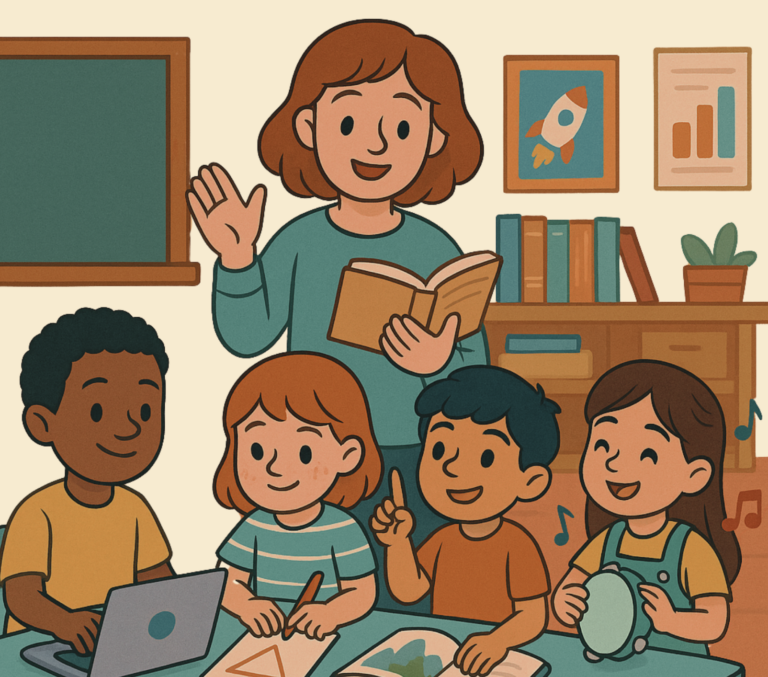
In early childhood settings, UDL is particularly valuable. Young children learn best when they can move, play, and explore. Pamela Brillante and Lillian Reddy (2017) have shown that UDL supports children of all languages, cultures, and abilities by blending storytelling, music, art, and movement into learning. These varied approaches help each child connect to the material in a meaningful way.
Why UDL Matters
When teachers use UDL, they shift from seeing differences as challenges to seeing them as opportunities. A classroom built on UDL principles is one where every student can find a path to understanding, whether through pictures, stories, hands-on activities, or technology.
Most importantly, UDL reminds us that equity in education is not about treating every student the same. It’s about giving each one the tools and opportunities they need to learn and thrive.
References
- Brand, S., & Dalton, E. (2012). Universal Design for Learning: Cognitive Theory into Practice for Facilitating Comprehension in Early Literacy.
- Brillante, P., & Reddy, L. (2017). Universal Design for Learning in the Early Childhood Classroom: Teaching Children of all Languages, Cultures, and Abilities, Birth–8 Years.
- Edyburn, D. (2005). Universal Design for Learning.
- King-Sears, P. (2014). Introduction to Learning Disability Quarterly Special Series on Universal Design for Learning.
- Pisha, B., & Coyne, P. (2001). Smart From the Start.
- Rose, D. (1999). Universal Design for Learning. The SAGE Encyclopedia of Higher Education.