
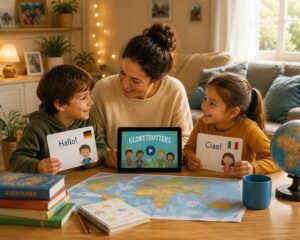
Why you can help your kids learn languages even if you don’t speak all languages
Do you need to make your child repeat a Greek word ten times for it to “stick”? Should every car ride turn into a German vocabulary quiz?
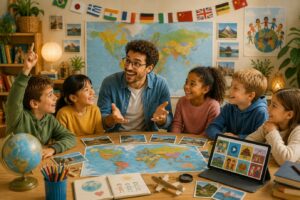
Why you can teach languages in class even if you don’t speak all languages?
You don’t speak Greek. You’ve never set foot in Romania. Dutch seems unpronounceable to you. And yet you’re being asked to introduce seven European languages to your class.
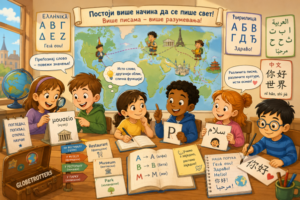
What children learn when they discover other alphabets and scripts
Learning about different alphabets and writing systems is one of the most effective ways to foster children’s curiosity, cognitive flexibility, and appreciation of cultural diversity.
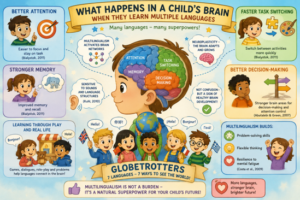
What happens in a child’s brain when they learn multiple languages
Learning multiple languages during early childhood offers far more than the ability to communicate in different languages.
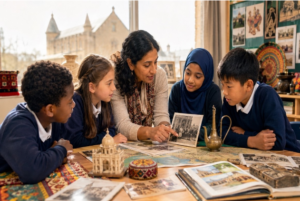
Why we need to talk about Heritage in Primary education
Why we need to talk about Heritage in Primary education Cultural heritage is often mistakenly viewed as just a collection of ancient monuments or dusty
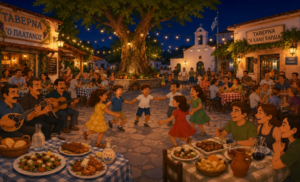
From festivals to food, exploring cultures with kids
From festivals to food, exploring cultures with kids In a world where cultural connections are expanding and human mobility is increasing, cultural understanding has become a vital necessity. Culture
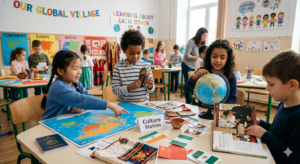
The mirror on the wall: why a child needs to see others to truly see themselves
The mirror on the wall: why a child needs to see others to truly see themselves We all want our children to be confident.
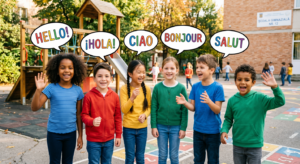
Why Knowing “Hello” in 10 European Languages is Your Secret Weapon
Why Knowing “Hello” in 10 European Languages is Your Secret Weapon Look, you don’t need to be a professor or a spy. But if
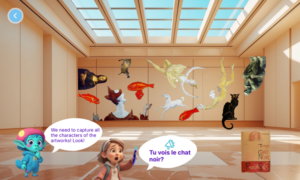
Not one brain, not one way: Designing learning materials for neurodiverse students
Not one brain, not one way: Designing learning materials for neurodiverse students Spend a few minutes observing children learning and one thing becomes obvious
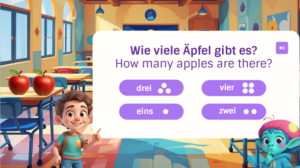
More than a seat in the classroom: what inclusion really looks like in practice
More than a seat in the classroom: what inclusion really looks like in practice Walk into a truly inclusive classroom and you will notice

Learning with Joy: Another Key to Successful Language Learning for Children
Learning with Joy: Another Key to Successful Language Learning for Children Learning a language… with pleasure? In a Europe shaped by linguistic and cultural
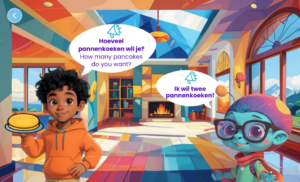
Giving Meaning to Learning: A Key for Children’s Language Learning
Giving Meaning to Learning: A Key for Children’s Language Learning Learning a language… but why? In a Europe rich in linguistic and cultural diversity,
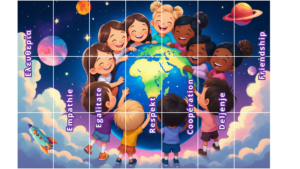
The Globetrotters Digital Platform: Integrating Language, Culture and Play
Imagine learning a language as a journey, not as a lesson, but as an adventure. In the world of Globetrotters, children don’t learn language by heart, they discover it.
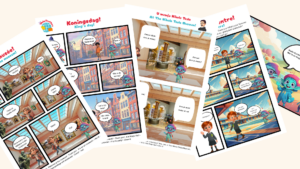
The Multimodal Potential of Comics as a Pedagogical Tool in Contemporary Language Teaching
Contemporary education increasingly requires teaching approaches that move beyond traditional, linear models of language learning and address the needs of digitally oriented and visually sensitive learners. In this context, comics have gained recognition as an effective didactic tool that integrates verbal and visual elements into a coherent narrative structure.
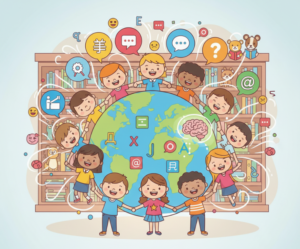
Language Awareness in Pre-Primary and Primary School: A Seed for Lifelong Learning
Language Awareness in Pre-Primary and Primary School: A Seed for Lifelong Learning As a consequence of migration, globalization, and increasing mobility, modern societies are characterized
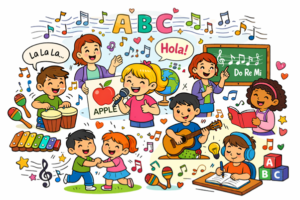
Rhythm, Music and Language: Natural allies in language learning
Rhythm, Music and Language: Natural allies in language learning Music and language are two of the most basic forms of communication available to us as
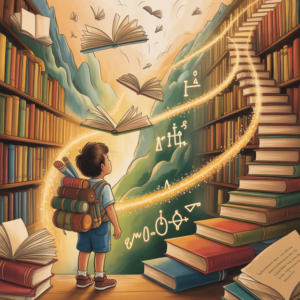
How to Design Learning That Feels Like an Adventure
For too long, the experience of learning has been framed as a chore. It is presented as a mountain of information to be scaled, a bitter medicine to be swallowed for the sake of future success. The classroom becomes a passive lecture hall, the corporate training a mandatory slideshow, and the personal goal a dusty textbook. But what if we reframed this entire process? What if, instead of a grim ascent, learning felt like setting sail for uncharted territories? What if it felt like an adventure?
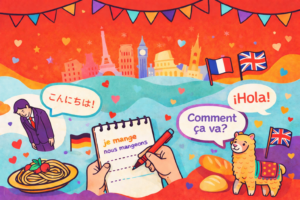
Why Learning a Language Through Culture, Not Just Grammar, is the Key to Fluency
For generations, the blueprint for language learning has been remarkably consistent: a textbook, a list of vocabulary, and the formidable scaffold of grammar rules. Students diligently memorize verb conjugations, struggle with case systems, and fill in countless worksheets. Yet, so many emerge from this process able to construct a sentence, but utterly unable to connect with a native speaker. They possess the bones of the language, but none of its soul. The missing ingredient, the vital spark that transforms a mechanical exercise into a living skill, is culture.
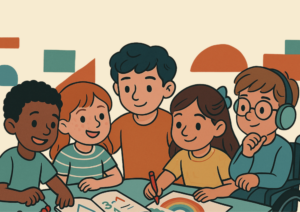
Valuing Difference: The Strength of Diverse Learning Needs
Every classroom is filled with children who see, think, and learn in their own ways. For a long time, education tended to focus on what children struggled with, especially those with special educational needs. Yet research consistently reminds us that these children also bring remarkable strengths that deserve recognition. When we look at the whole child, rather than only the challenges they face, we see potential that might otherwise be overlooked.
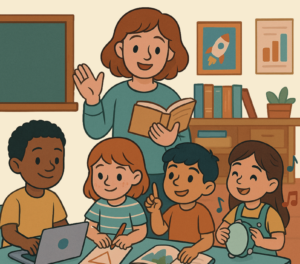
Universal Design for Learning: Making Materials Work for Everyone
In every classroom, children come with different stories, strengths, and ways of learning. Some grasp ideas best through words, others through images, sound, or movement. Yet for too long, teaching has often been designed with a single “typical” learner in mind. This approach can leave many students behind, from those with learning differences to those who are simply wired to learn in other ways.
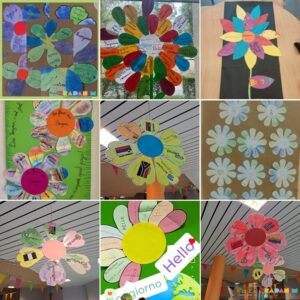
Bringing Language Awareness to Life in the Classroom
Bringing Language Awareness to Life in the Classroom A Dynamic and Cross-Curricular Approach Language Awareness is not an isolated subject. It connects all disciplines :
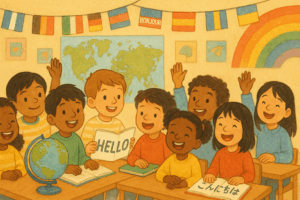
Language Awareness: A European Approach to Opening the World to Children
Language Awareness: A European Approach to Opening the World to Children A Shared European Vision Language Awareness is a playful, inclusive and global approach that invites children,
Digital Applications Supporting Role-Playing in Language Learning
Role-play as a language-learning strategy is gaining increasing prominence in digital education because it enables learners to practice a foreign language in authentic yet low-risk situations. Through this approach, students simulate real-life interactions, such as ordering food in a restaurant, speaking at a service counter, or negotiating, thereby not only mastering linguistic structures but also cultivating creativity, spontaneity, and confidence in communication.
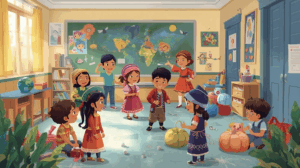
Language in Their Shoes – Role Playing in Language Learning
As it has long been known in the psychological development of children, a child experiences the world with all their senses, learns and acquires knowledge using speech, rhythm, movement, image, and play. The connection between play and learning is completely natural and part of a child’s earliest experiences. Playing has a very important role in the development of a child’s personality, and therefore, as a tool in the school learning process, it gains even greater significance.
Why Games Belong in the Classroom
At first glance, it may seem paradoxical to associate the words “game” and “learning”, as in many educational systems, the classroom is still a space of discipline, efficiency, and predefined learning objectives. It is not considered a place for games, storytelling, or imaginative play. Yet, increasingly, research urges us to reconsider this perspective.
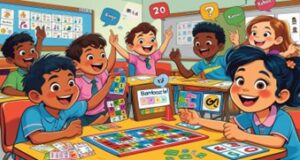
Games that boost language learning
Imagine a classroom buzzing with energy, not from disruption, but from focused, joyful engagement. Students are laughing, thinking, moving, and most importantly, using the target language without fear.
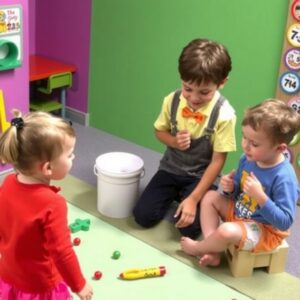
The Power of Role Play in Teaching Languages and Culture in Early Childhood
In early childhood education, learning is most effective when it is playful, meaningful, and rooted in real-life experiences. One of the most powerful strategies for achieving this is role play. When children take on different roles, such as a shopkeeper, parent, or traveller, they not only expand their imagination but also practice essential language and social skills in a fun and memorable way.
Learning by Doing: The Role of Interactive Storytelling
In early childhood education, the most effective learning happens through experience. Young children learn best not by listening passively but by engaging actively: touching, moving, speaking, pretending, and imagining.
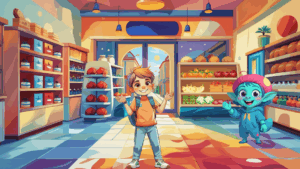
Why It’s Never Too Early to Learn a Language
Language is more than vocabulary, it’s a way of seeing the world, a vehicle for identity, and a gateway to other cultures. And the earlier children are exposed to other languages, the deeper and more natural this learning becomes.

Globetrotters: Learning Languages, Discovering Cultures, Connecting Worlds
In a world where borders feel increasingly virtual, and difference is a daily encounter, education has the power to do something extraordinary: to prepare children not just for tests, but for life together. That’s the heartbeat behind the Globetrotters project, an ambitious European initiative that brings language discovery, cultural curiosity, and inclusive learning into the early years of education.