
More than a seat in the classroom: what inclusion really looks like in practice
Walk into a truly inclusive classroom and you will notice something straight away. It does not feel like a place where some children are being “supported” while others follow the lesson. It feels like a space where everyone belongs. Some children are speaking, others are moving, and a few are quietly observing. Yet they are all part of the same learning experience. The key idea behind inclusion is about designing learning environments that work for everyone from the beginning, not about adding extra support for a few learners.
Research on inclusive education consistently shows that access alone is not enough. What matters is participation and belonging. When children are able to engage in shared activities while receiving the support they need, their academic and social outcomes improve significantly (Kefallinou et al., 2020). Inclusion is not simply a structural change, but a shift in how we think about teaching.
One of the most effective ways to support inclusion in practice is to offer flexible ways of learning. Children do not all process information in the same way, and approaches like the UDL, Universal Design for Learning, encourage teachers to present content through multiple formats, such as visuals, audio, and interaction (Almeqdad et al., 2023). This flexibility reduces barriers before they even appear and allows more children to access the same content without needing separate adaptations.
Another important element is interaction. Inclusive classrooms are not quiet, individual spaces where each child works alone at their own level. They are social environments where learning happens through collaboration. Studies show that when children work together, they not only develop language and cognitive skills but also empathy and confidence (Kefallinou et al., 2020). Inclusion becomes something that is lived, not just planned.
In practice, this also means accepting that children will not all express their learning in the same way. Some may speak, others may draw, and some may demonstrate understanding through action. The goal is not to standardise how learning is shown, but to make sure that every child has a meaningful way to participate.
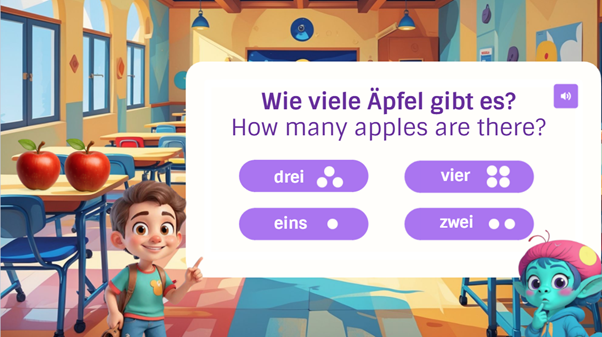
This approach is at the heart of the Globetrotters project. Instead of designing language learning around one “ideal” learner, the activities offer multiple entry points. Digital games combine sound, images, and interaction, allowing children to engage in different ways. Storytelling and role play allow them to express language through movement, voice, or imagination. Cultural contexts make learning more concrete and meaningful, which supports understanding for a wide range of learners.
What is important here is that inclusion is not treated as an adaptation. It is built into the design. A child does not need to struggle first to receive support. The environment is already flexible enough to include them.
Inclusive practices benefit all learners, not only those with identified needs. When lessons are more interactive, meaningful, and adaptable, engagement increases across the whole group. What supports one child often supports many others as well (Almeqdad et al., 2023). In this sense, inclusion is not an additional effort. It is simply good teaching.
At the same time, research also reminds us that inclusion is not always easy to implement. Teachers often face challenges in balancing diverse needs and adapting their practices (Kefallinou et al., 2020). This highlights the importance of practical tools, collaborative approaches, and well-designed resources that make inclusion realistic in everyday classrooms.
In the end, inclusion is less about methods and more about mindset. It starts with the idea that differences are not obstacles to overcome, but natural parts of learning. When education is designed with this in mind, classrooms become places where every child can participate, contribute, and grow.
References
Almeqdad, Q. I., Alodat, A. M., Alquraan, M. F., Mohaidat, M. A., & Al-Makhzoomy, A. K. (2023). The effectiveness of universal design for learning: A systematic review and meta-analysis. Cogent Education, 10(1). https://doi.org/10.1080/2331186X.2023.2218191
Kefallinou, A., Symeonidou, S., & Meijer, C. (2020). Understanding the value of inclusive education and its implementation: A review of evidence. European Agency for Special Needs and Inclusive Education. https://pmc.ncbi.nlm.nih.gov/articles/PMC8116690/