
Why we need to talk about Heritage in Primary education
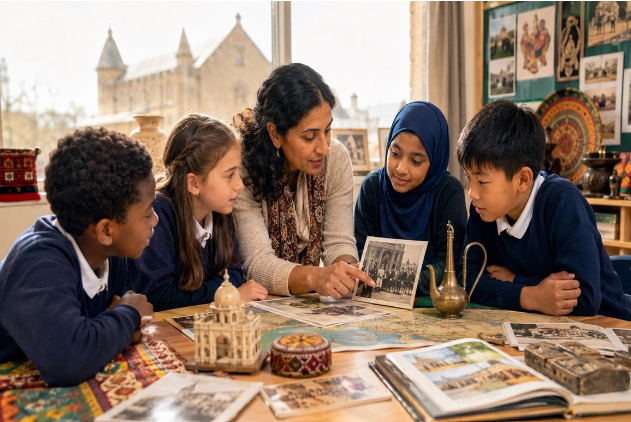
Cultural heritage is often mistakenly viewed as just a collection of ancient monuments or dusty museum artifacts. However, the sources reveal it is actually a common good that requires a continuous training strategy starting from the very first years of school life (Achille & Fiorillo, 2022). Talking about heritage in primary education is not just a secondary task. It is essential for aligning our schools with the 2030 Agenda for Sustainable Development, particularly the goals of quality education and creating sustainable communities (Achille & Fiorillo, 2022).
In fact, a 2017 survey showed that 88% of European citizens agree heritage should be taught in schools because it explains our history and culture (European Commission, 2024). One of the most compelling reasons to include heritage in the primary curriculum is its capacity for active didactics (Achille & Fiorillo, 2022). Rather than listening to passive lectures, children can learn through direct experience and analysis of cultural assets (European Commission, 2024).
Research shows that when primary students engage with heritage, the results are immediate: they demonstrate significant conceptual learning, successfully identifying the names and locations of local sites, and they undergo rapid vocabulary development, learning specific architectural terms to describe their world (Achille & Fiorillo, 2022). For example, by using a map to follow a path or playing educational games, students improve their spatial orientation and critical thinking (Achille & Fiorillo, 2022). Games, in particular, provide a motivating way to raise awareness (Castro-Calviño, Rodríguez-Medina, & López-Facal, 2020). One specific tool mentioned is the game “Detective a Laorca,” which uses riddles to help children discover architectural features (Achille & Fiorillo, 2022). Similarly, in Malaysia’s primary curriculum (KSSR), traditional games like konda kondi are used in Physical Education to preserve local legacy (Barghi et al, 2017). These activities show that we can provide education through heritage, using cultural assets as a fun, cross-curricular medium to teach other subjects like history, art, and even physical health (Barghi et al, 2017).
This is precisely the objective pursued by our Erasmus+ project, a consortium of four countries, known as “The Globetrotters.” By developing original didactic materials grounded in everyday contexts – such as visits to restaurants, museums, or walks in the park – the initiative constructs meaningful learning scenarios that integrate cultural heritage education into familiar experiential frameworks. In doing so, it facilitates the pedagogical translation of abstract cultural concepts into accessible, relatable situations for primary school pupils, enhancing both engagement and comprehension (https://globetrottersproject.eu).
Beyond academics, heritage education is vital for identity configuration. In primary school, children begin to move from a narrow focus on themselves to a broader cultural conscience (Martínez-Rodríguez & Fontal, 2020). This process helps them develop a civic sense and a proactive attitude toward protecting their environment (Achille & Fiorillo, 2022). By learning about the past, children develop an intercultural perspective that promotes a more just and inclusive society (Martínez-Rodríguez & Fontal, 2020). They learn to value diversity and realize that they are part of a school community that stretches from the local to the international level (Martínez-Rodríguez & Fontal, 2020).
Despite these benefits, there is a significant wide gap between what the curriculum requires and the training teachers actually receive (Martínez-Rodríguez & Fontal, 2020). Many primary teachers hold a deficient view of heritage because only about 31.1% received heritage-related instruction during their university degrees (Jiménez, Cuenca & Ferreras, 2010). This lack of training creates epistemological barriers, making it hard for educators to understand how to teach these complex topics effectively (Jiménez, Cuenca & Ferreras, 2010). Without a dedicated focus, heritage is often treated as a mere “stopgap” rather than being at the very core of education (European Parliament, Committee on Culture and Education, 2018).
To ensure our children grow up as responsible guardians of our collective memory, we must bridge this gap. Heritage is an important resource for economic growth and social cohesion, supporting millions of jobs and revitalizing communities (European Commission, 2024). By putting heritage at the heart of primary education through play, research, and community involvement, we provide students with the social and civic competence they need for the 21st century (Castro-Calviño, Rodríguez-Medina, & López-Facal, 2020). Only what is truly known and valued by our children today can be protected and preserved for the generations of tomorrow (Martínez-Rodríguez & Fontal, 2020).