
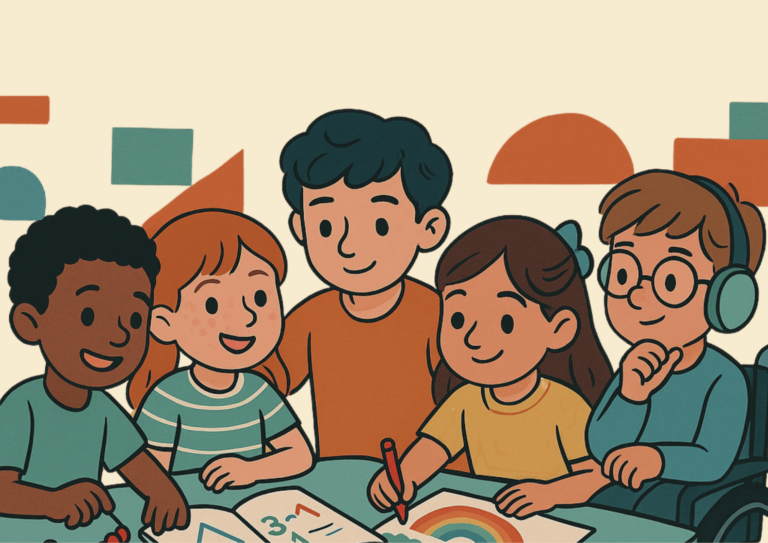
Valuing Difference: The Strength of Diverse Learning Needs
Every classroom is filled with children who see, think, and learn in their own ways. For a long time, education tended to focus on what children struggled with, especially those with special educational needs. Yet research consistently reminds us that these children also bring remarkable strengths that deserve recognition. When we look at the whole child, rather than only the challenges they face, we see potential that might otherwise be overlooked.
Why One-Size-Fits-All Approaches Fall Short
- Gervasoni’s 2005 study on young learners struggling with number concepts highlighted something important. Even when children share the same broad difficulty, their individual learning needs can vary widely. Some may benefit from hands-on activities, while others may benefit from visual support or extra time. Because of this variety, rigid or formulaic intervention programmes rarely work well. Children thrive when the support they receive is flexible enough to adapt to their personal learning profile. This research pushes us to rethink the idea of “typical” learners. It reminds us that labels like “struggling in maths” say very little about what a child actually needs.
Strengths and Weaknesses: A More Complete Picture
A few years later, Everatt and colleagues (2008) examined children with dyslexia, dyspraxia, attention difficulties, and other learning differences. Their findings showed that children in these groups displayed distinctive patterns of strengths and weaknesses. When assessments included both aspects, it became easier to understand each learner’s unique profile.
This matters because it changes the way we support children. A child with dyslexia might have exceptional reasoning skills. A child with dyspraxia could be highly imaginative. A child with attention challenges may be deeply curious and quick-thinking. When adults recognise and use these strengths, children feel more confident and motivated to learn.
Inclusive Education as a Strength-Based Mindset
Educational authors such as Ashman and Elkins (2002) and Loreman and colleagues (2004) have long argued that inclusion works best when teachers understand and value diversity. Instead of expecting all children to follow the same path, inclusive practices encourage flexibility, empathy, and creativity. This approach not only benefits children with identified learning needs. It helps every learner by creating a classroom environment where different strengths are acknowledged and celebrated.
Participation Grows When Strengths Are Valued
Teachers who use strength-based approaches often see higher levels of engagement. Beneke and Ostrosky (2009) found that when classrooms used the Project Approach, children with diverse learning needs became more active participants. They interacted more with their peers, showed greater confidence, and made steady progress both socially and academically. The learning environment became a place where their abilities were recognised instead of overshadowed by their challenges.
This idea is echoed in Jenifer Fox’s work Your Child’s Strengths (2008), which emphasises that identifying and nurturing children’s talents helps them build resilience and a strong sense of self. When children feel valued for what they can do, they become more open to tackling difficult areas.
Creating a Classroom Culture That Celebrates Difference
Recognising strengths is not only about assessments or interventions. It is about building a classroom culture where every child feels seen. Here are some guiding ideas:
- See the whole child: A child’s difficulty is only one aspect of who they are. Their imagination, empathy, memory, humour, determination, or creativity are just as important.
- Stay flexible: Children with diverse learning needs rarely follow the same pattern. Flexibility gives teachers the space to adjust and respond to what each learner shows in the moment.
- Use strengths as a starting point: If a child learns best through movement, imagination, visuals, or hands-on exploration, those strengths can become the doorway into new learning.
Conclusion: Difference Makes Us Stronger
The research is clear. Children with diverse learning needs bring meaningful strengths that should be recognised and nurtured. When educators shift from focusing on deficits to embracing a fuller, more balanced picture of each learner, classrooms become more inclusive and more effective.
Valuing difference does not mean ignoring challenges. It means understanding that every child has something to contribute. When we build on the strengths of diverse learners, we help them grow into confident individuals who know that their differences are not obstacles but sources of power.
Sources:
Ashman, A., & Elkins, J. (2002). Educating children with diverse abilities (2nd ed.). Pearson Education.
Beneke, S., & Ostrosky, M. M. (2009). Teachers’ views of the efficacy of incorporating the project approach into classroom practice with diverse learners. Early Childhood Research & Practice, 11(1). https://ecrp.illinois.edu/v11n1/beneke.html
Everatt, J., Weeks, S., & Brooks, P. (2008). Profiles of strengths and weaknesses in dyslexia and other learning difficulties. Dyslexia, 14(1), 16–41. https://doi.org/10.1002/dys.342
Fox, J. (2008). Your child’s strengths: Discover them, develop them, use them. Viking Press.
Gervasoni, A. (2005). The diverse learning needs of young children who were selected for an intervention program. [Doctoral dissertation, La Trobe University].
Loreman, T., Deppeler, J., & Harvey, D. (2004). Inclusive education: A practical guide to supporting diversity in the classroom. Routledge.