
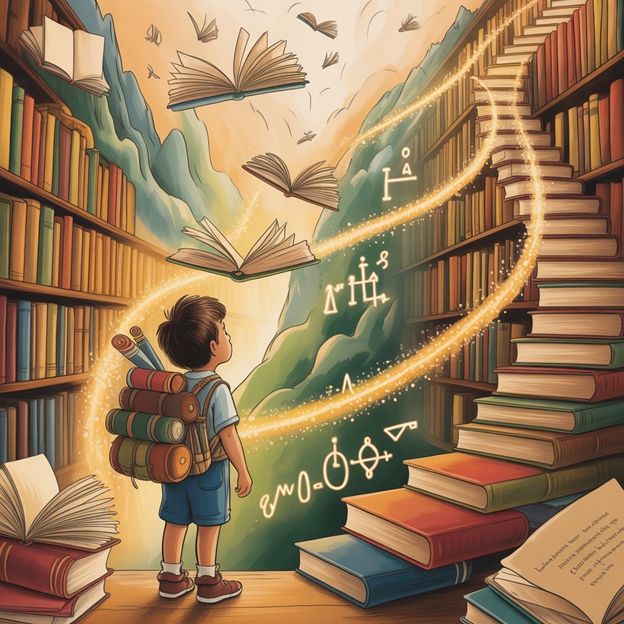
How to Design Learning That Feels Like an Adventure
For too long, the experience of learning has been framed as a chore. It is presented as a mountain of information to be scaled, a bitter medicine to be swallowed for the sake of future success. The classroom becomes a passive lecture hall, the corporate training a mandatory slideshow, and the personal goal a dusty textbook. But what if we reframed this entire process? What if, instead of a grim ascent, learning felt like setting sail for uncharted territories? What if it felt like an adventure?
The human brain is not wired for passive consumption; it is wired for exploration, problem-solving, and stories. An adventure, by its very nature, taps into our deepest motivations: curiosity, a sense of purpose, and the thrill of discovery. Designing learning as an adventure isn’t about adding gimmicks; it’s about fundamentally restructuring the experience to align with how we naturally engage with the world. It transforms the learner from a passive recipient into the active hero of their own journey.
The first step in this transformation is to craft a compelling “Call to Adventure.” In any great story, the hero is presented with a mission that is both meaningful and slightly daunting. In learning, this replaces the generic “You need to learn this.” Instead, pose a central question, a mystery, or a meaningful challenge. A history lesson shouldn’t start with “Open your book to chapter four,” but with “You are a detective in 1929. The stock market has just crashed. Your mission is to uncover three reasons why this happened and predict the consequences for an average family.” A software training shouldn’t be “Here are the features of the new CRM,” but “A key client is threatening to leave. You have 24 hours to use our new system to find their history and save the account.” The “why” becomes the epic quest, making the “what” (the content) a crucial tool for success. Or, just like in Globetrotters project “You are an alien discovering the earth and its many languages. Visit all the destinations to learn tools to live together”.
Next, the learning path must be structured as a series of quests, not a linear syllabus. A long, monotonous journey is exhausting. An adventure is broken down into exciting, achievable chapters. Divide the learning objectives into a sequence of missions or levels. Each level should have a clear goal, a tangible reward (like a badge, a new “power,” or a piece of a larger puzzle), and a “boss level”—a challenge that requires the learner to apply all they’ve learned in that section. For a language learner, Level 1 might be “The Greeting,” where the mission is to successfully order a coffee. Level 10 might be “The Negotiation,” where they have to successfully haggle at a market in a foreign film. This gamified structure provides a constant sense of progression and accomplishment. In Globetrotters project instead of learning about all languages at once, the quest is divided amongst 7 countries, each country is divided in three places where they can learn about different subjects, be it linguistic or cultural, and get clues to solve the great quest.
Crucially, an adventure requires a map and a compass, not a rigid set of instructions. Provide learners with the tools and resources to navigate the challenges themselves. Instead of a step-by-step guide, give them a “treasure map” that hints at the solution. In a science class, this might mean providing raw data and the scientific method, then asking students to discover the principle themselves. In a science class, students might analyze how plant growth varies with colored light filters to deduce photosynthesis principles. The struggle to find the path is where the deepest learning occurs. This element of choice and discovery fosters autonomy and critical thinking, making the learner feel like a true explorer, not just a tourist on a predetermined route.
No hero adventures alone. The fellowship is a cornerstone of any great tale. Social learning transforms a solitary grind into a collaborative quest. Design opportunities for learners to form teams, share discoveries, and overcome challenges together. This could be through study groups framed as “guilds,” peer review presented as “allies sharing intelligence,” or collaborative projects where each member brings a unique “skill” to the table. Or by becoming a Globbytrotty alongside their classmate. The social element provides support, introduces diverse perspectives, and creates a shared narrative that enhances retention and makes the process more enjoyable.
Finally, every adventurer needs feedback that fuels the journey. Traditional feedback often feels like a judgment, a red mark on a paper. In an adventure-learning model, feedback is reframed as clues, lore, and guidance from a wise mentor. Instead of “Incorrect,” the system might say, “Your strategy didn’t work. The dragon was immune to fire. Try using the ice spell you learned in the Frost Caves.” This keeps the learner in the narrative, frames failure as a necessary part of the discovery process, and provides clear, contextual direction for improvement. The final “treasure” or “victory” is not just a grade, but a demonstrable mastery of the skill, a portfolio, a created product, or the ability to solve a real-world problem.
Designing learning as an adventure requires a shift in mindset for both educators and learners. It moves from a content-delivery model to an experience-design model. It asks us to be not just experts, but game masters, storytellers, and guide.
The result, however, is transformative. Learners are no longer just storing information; they are living it. They are not just preparing for a test; they are preparing for the real, unpredictable world by practicing resilience, creativity, and problem-solving in a dynamic environment. By turning the page from a textbook to a treasure map, we don’t just teach people what to know. We inspire them with the endless thrill of discovering what is possible. The quest awaits.
References