
Rhythm, Music and Language: Natural allies in language learning
Music and language are two of the most basic forms of communication available to us as humans. From the earliest moments of human history, music has been a fundamental means of non-verbal communication and expression and has been used from an early age in the upbringing and education of children (Tzanakis, 2002). From a very young age, children come into contact with language not only through words, but also through rhythm and melody. When we talk to infants, we often raise our voices—we emphasise words, sing short phrases or repeat sounds—and in this way children begin to learn language (Koelsch, 2025).
The relationship between music and language has been studied extensively in recent years. Music is not just entertainment; it is a tool that can contribute positively to language development, a child’s overall school performance and creativity. Learning to play a musical instrument in particular enhances fine motor coordination and concentration. At the same time, music helps children develop self-confidence, emotional sensitivity, and social skills such as cooperation and teamwork. Music also cultivates self-discipline and provides a means of relaxation and emotional expression, elements that contribute to children’s overall well-being (Hallam, 2010).
The aim of this article is to show in a practical and understandable way how rhythm, music and language can be used in language learning, both in the mother tongue and in foreign languages, with an emphasis on pedagogical applications in the classroom.
Music and children’s brains
Music and language are processed in the brain in a similar way. Both are based on auditory patterns, rhythm and structure. Neuroscience shows that when a child listens to music or speaks, common areas of the brain are activated (Koelsch, 2025). This means that music is not something “separate” from language; on the contrary, it can enhance the development of language skills. This common “music and language network” is already functioning from infancy, indicating that the connection between music and language is deep and biologically grounded (Koelsch, 2025).
In recent years, there has been growing interest in how the human brain functions in relation to music and how music education affects language development, perception and memory. Music is an important tool for understanding the complex functions of the brain (Mantzikos, 2015).
Neurobiologist Carla Shatz of the University of California, Berkeley, emphasises that the infant brain is not simply a miniature version of the adult brain, but a dynamically changing structure. This explains how infants learn language at a rapid pace and recognise the sounds of their native language at six months of age (Triarchou, 2015).
Research shows that students who participate in additional music lessons perform better in reading and writing compared to students who do not have music education. These findings highlight the important role of music in children’s educational and cognitive development (Mantzikos, 2015).
Children who have musical training seem to have a better understanding of syntax and grammar because their brains respond more effectively by reducing linguistic errors, whether these occur in a sentence or in a musical phrase (Jentschke & Koelsch, 2009). This opens up important possibilities for pedagogy: music can be used as a means of enhancing language, especially in children who have difficulties in reading, writing or understanding speech.
Research also shows that music affects memory, attention and concentration (Hallam, 2010). Children who are actively involved in music learn to notice details in sound and rhythm, skills that transfer to language learning and the ability to understand complex sentences.
Music, memory and vocabulary
Music acts as a ‘bridge’ for memory. Melodies and repetitive rhythms help children remember words and phrases more easily. This explains why songs are so useful in learning vocabulary: lyrics stick in the mind more quickly and in an enjoyable way.
Phonological awareness—the ability to hear, recognise, and manipulate the sounds of language—is significantly enhanced by music education (Gordon et al., 2015). Research shows that children who participate in musical activities perform better in reading and writing skills (Eccles et al., 2020). Simple examples include rhymes, children’s songs and sound games, which can be incorporated into everyday language lessons.
For teachers, this means that music can be a tool that enhances learning without replacing traditional teaching methods. In fact, the combined use of music and language can make learning more natural, enjoyable and effective.
Emotional engagement and motivation
Music has a powerful emotional impact. It creates a positive atmosphere, reduces stress and increases children’s active participation (Hallam, 2010). In language teaching, this is very important: students who feel comfortable and happy during class learn faster and have greater self-confidence.
The use of songs and musical games also increases empathy and cooperation among students, enhancing social learning. When students learn together through music, they develop communication and collaboration skills, which are crucial for language development (Hallam, 2010; Kryeziu & Maliqi, 2025).
Rhythm, melody and pronunciation
For thousands of years, people have used rhythm in activities such as percussion instruments, dance and singing. Rhythm helps people communicate and connect with each other, as it naturally links hearing with movement. Even a simple beat can spontaneously lead to movements such as clapping, marching or rhythmic vocalisations (Fujii & Wan, 2014).
Studying the relationship between rhythm and speech is important not only for better understanding how human communication has developed, but also for supporting individuals with speech and language difficulties. Research shows that rhythm can have a therapeutic effect, helping to restore speech and language skills in neurological disorders (Fujii & Wan, 2014).
Prosody, i.e. the rhythm and melody of speech, is extremely important for understanding and producing language. Many children have difficulty speaking correctly even if they have a good vocabulary because they do not understand the natural rhythm and intonation of words (Degrave, 2021).
Musical activities that focus on rhythm, with percussion instruments, body percussion, or songs with repetitive patterns, help children develop a sense of rhythm and improve their pronunciation (Fujii & Wan, 2014; Drakoulaki et al., 2025). At the same time, the repetition of musical patterns contributes to phonological development and correct articulation.
Pedagogical applications in the classroom
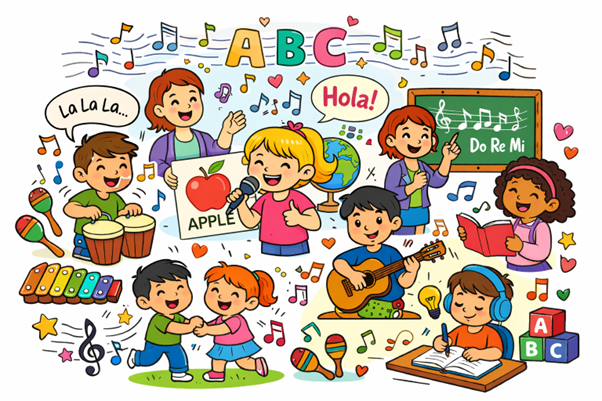
Music can be incorporated into language lessons in many ways. Some practical ideas include:
- Songs and rhymes: Choose simple songs with clear pronunciation and repetitive phrases. Children can sing, accompany with their bodies (body percussion) or percussion instruments, and experiment with changes in the lyrics. In this way, they learn new words and expressions through rhythm and melody (Makropoulou & Varelas, 2005).
- Music and movement games: We organise activities where children move to the rhythm of the music, imitate sounds and words, or create their own musical patterns. This method combines language learning with physical activity and strengthens memory (Makropoulou & Varelas, 2001).
- Setting texts to music: Short poems or literary texts can be set to music, giving children the opportunity to process them rhythmically and melodically. This enhances memory, phonological awareness and word-sound association (Tzanakis, 2002).
- Intercultural songs: We use songs from other countries to introduce new languages and cultures. Children learn expressions, pronunciation and vocabulary in a natural and experiential way, while developing respect and interest in other cultures (Kryeziu & Maliqi, 2025).
- Creating musical stories: Children can make up their own songs or short stories with musical accompaniment. This activity enhances creativity, expression and speech production, as children have to organise words and phrases within a musical context.
Benefits for children with special needs
Music has also been shown to have positive effects on children with developmental disorders, dyslexia or delayed language development. Rhythmic and melodic repetition facilitates the learning of words and sentences, while music creates a safe and enjoyable learning environment (Mantzikos, 2015).
The use of songs and rhythmic games can improve phonological awareness, memory and social interaction, offering a holistic approach to education (Hallam, 2010; Eccles et al., 2020).
Music and language are not two separate things; they are closely linked. Music can:
- Enhance memory and vocabulary.
- Improve phonological awareness and pronunciation in foreign language learning.
- Create motivation for learning
- Improve social skills
- Reduce stress and increase the active participation of all children
- Support language learning in children with special needs.
- Develop interest in and respect for other cultures
- Increase children’s attention and concentration levels
- Help restore speech and language skills in people with neurological disorders
- Cultivate self-confidence and self-discipline in children
Teachers can incorporate musical activities into their lessons as long as they are willing to experiment. Songs and rhythmic games can be used, and lyrics can be set to music, taking advantage of children’s natural curiosity and joy in musical creation.
In this way, music becomes a valuable educational tool, making language learning more natural, enjoyable and effective.
BIBLIOGRAPHY
Degrave, P. (2021). The contribution of prosody to intelligibility, comprehensibility and accentedness in foreign language acquisition: Can music help?. Nederlandse Taalkunde, 26(2), 273-298. 10.5117/NEDTAA2021.2.006.DEGR.
Drakoulaki, K., Anagnostopoulou, C., Guasti, M. T., Mikros, G., Tillmann, B., & Varlokosta, S. (2025). Unveiling Predictors of Beat Perception and Rhythm Discrimination in Typically Developing Preschoolers. Music & Science, 8. https://doi.org/10.1177/20592043251383292
Eccles, R., van der Linde, J., le Roux, M., Holloway, J., MacCutcheon, D., Ljung, R., & Swanepoel, D. W. (2021). Effect of music instruction on phonological awareness and early literacy skills of five- to seven-year-old children. Early Child Development and Care, 191(12), 1896–1910. https://doi.org/10.1080/03004430.2020.1803852
Fujii, S., & Wan, C.Y. (2014). The Role of Rhythm in Speech and Language Rehabilitation: The SEP Hypothesis. Frontiers in Human Neuroscience, 8. 777. 10.3389/fnhum.2014.00777.
Gordon, R., Fehd, H., & Mccandliss, B. (2015). Does Music Training Enhance Literacy Skills? A Meta-Analysis. Frontiers in Psychology, 6. 10.3389/fpsyg.2015.01777.
Hallam, S. (2010). The power of music: Its impact on the intellectual, social and personal development of children and young people. International Journal of Music Education, 28(3), 269-289. https://doi.org/10.1177/0255761410370658
Jentschke, S., & Koelsch, S. (2009). Musical training modulates the development of syntax processing in children. Neuroimage, 47(2), 735-44. doi: 10.1016/j.neuroimage.2009.04.090.
Koelsch S. (2025). Music and Language in the Brain. In Good Vibrations: Unlocking the Healing Power of Music (pp. 28-38).Cambridge University Press.
Kryeziu, D., & Maliqi, F. (2025). The Impact of Music on English Language Learning. Yegah Müzikoloji Dergisi, 8. 1706-1725. 10.51576/ymd.1690790.
Lee, Y.S., Ahn, S., Holt R.F., Schellenberg E.G. (2020). Rhythm and syntax processing in school-age children. Dev Psychol, 56(9), 1632-1641. Doi:10.1037/dev0000969.
Makropoulou, E., & Varelas, D. (2001). I mousiki: To pio synarpastiko paixnidi. Fagotto.
Makropoulou, E., & Varelas, D. (2005). Tragoudontas lexeis. Fagotto.
Mantzíkos, N. K. (2015). I mousiki therapevei: I therapeftiki drasi tis mousikis stis anaptyxiakes diataraches. Thessaloniki: iWrite.gr.
Pino, M., C., Giancola, M., & D’Amico, S. (2023). The Association between Music and Language in Children: A State-of-the-Art Review. Children (Basel), 10(5), 801. 10.3390/children10050801.
Schön, D. (2009). [Review of the article Music, Language, and the Brain, by Aniruddh Patel]. Music Perception, 26(3), 287–288. https://doi.org/10.1525/mp.2009.26.3.287
Triarchou, L. (2015). Nevroviologikes vaseis stin ekpaidefsi. https://repository.kallipos.gr/handle/11419/5167
Tzanakis, P. (2002). I mousiki agogi os meso anaptyxis tou paidiou mesa apo tin analytikosynthetiki prosengisi tis mousikis kai tis glossas: Mia alli protasi didaktikis tis mousikis. In Mousiki ekpaidefsi: 3o Synedrio, Volos, 28–30 Iouniou 2002: Praktika (Vol. 11, No. 3, pp. 90–99).