
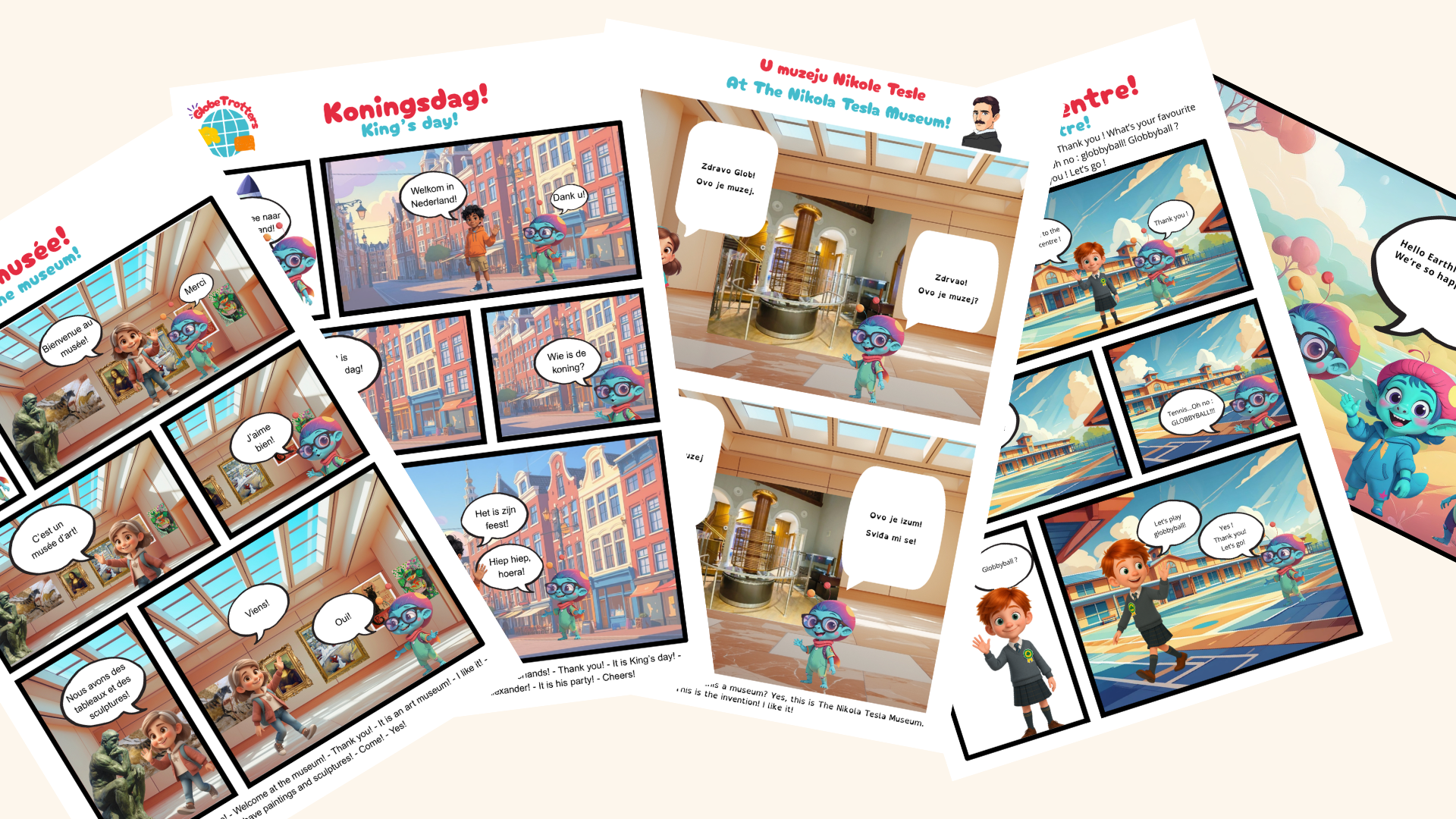
Illustrations of comics developed within the Globetrotters project
The Potential of Comics as a Pedagogical Tool in Language Teaching
Contemporary education increasingly requires teaching approaches that move beyond traditional, linear models of language learning and address the needs of digitally oriented and visually sensitive learners. In this context, comics have gained recognition as an effective didactic tool that integrates verbal and visual elements into a coherent narrative structure. As a multimodal text type, comics enable learners to acquire language through context, storytelling and interaction, thereby fostering motivation, comprehension and communicative competence (Paivio, 1991; Mayer, 2009).
Comics as a Multimodal Pedagogical Resource
Comics represent a form of multimodal discourse in which meaning is constructed through the interaction of images, written language, panel organization, and narrative flow. This multimodal structure allows learners to process information through multiple channels simultaneously. According to Dual Coding Theory, such parallel processing supports deeper understanding and more durable retention of language content (Paivio, 1991).
Visual support in comics reduces cognitive load and enables learners to understand meaning even when their linguistic competence is still developing. Rather than memorizing isolated vocabulary or grammatical forms, learners actively construct meaning by linking visual cues with textual information.
Motivation and Engagement
Research consistently shows that comics have a positive effect on learner motivation and emotional engagement in language learning contexts (Saraswati & Satyan, 2022). Comics are perceived as enjoyable and accessible, which lowers language anxiety and increases active participation, particularly among younger learners who connect emotionally with narrative characters.
Vocabulary Development and Reading Skills
One of the main pedagogical strengths of comics lies in their ability to present new vocabulary in context. Words appear in meaningful situations supported by illustrations, enabling learners to infer meaning without explicit explanation or translation. Empirical research shows that reading comics leads to significant incidental vocabulary acquisition, as the visual elements in comics allow learners to infer the meaning of new words from context and retain them for a longer period (Aliyar & Peters, 2023).
When used in early stages of language learning, comics support the acquisition of:
– basic vocabulary (colors, numbers, family, emotions, animals),
– simple sentence structures (e.g. I am…, I like…, This is…),
– meaning comprehension without explicit grammar instruction,
– logical sequencing of events (beginning-middle-end),
– basic spoken interaction through short dialogues.
Comics as a Tool for Creative and Active Learning
Beyond receptive skills, comics have great potential for productive language use. Creating comics encourages learners to actively use language through designing characters, dialogues, and developing narratives. Research shows that the use of comics in language teaching promotes creative expression and analytic thinking, as learners actively construct meaning through both verbal and visual modes (Badriah, 2025).
Through comic creation, learners can use a foreign language authentically and meaningfully, while engaging with cultural aspects.
Examples of Comic-Based Classroom Activities
- In the Globetrotters project, learners are introduced to child guide characters from different countries, as well as alien characters who travel across various European countries exploring their languages and cultures. Many of the Globetrotters physical activity boxes provide ready-to-print comics (e.g., French: At the Museum; Greek: At the Folk Festival; English: At the Sports Centre; Serbian: At the Nikola Tesla Museum; Dutch: At the Restaurant; German: At School). Additionally, the Globetrotters mini-games feature a comic-style visual design across both the physical activity materials and the digital platform with Genially, ensuring a coherent and engaging learning experience.
- Three-Panel Comic Activity: Learners create three-panel comics representing, for example,
My Day -morning, school and afternoon -adding one simple sentence to each panel (e.g., I wake up., I go to school., I play.). Students can either draw their comics themselves or use printed frames in which they paste cut-out images from old magazines or catalogs to create content.
- When working on Globettrotters project-based content, students can use characters previously introduced in the modules to create their own comics. Within the Globetrotters project, students select the characters they find most appealing, print and cut them out, and then arrange them within a pre-prepared comic template. The comic typically consists of three to four panels, organized around a topic of the learner’s choice. In each panel, students compose short dialogues to illustrate interactions between the selected characters, using vocabulary and expressions they have retained and found meaningful in previous modules.
Simple Digital Tools for Creating Comics
To fully utilize the educational potential of comics, learners should be provided with intuitive digital tools appropriate to their developmental level. When selecting digital comic-creation tools for younger learners, particular attention must be paid to content control and age-appropriateness. Tools that allow full teacher control over visual and textual elements, such as pre-designed templates in Canva for Education or offline comic creation, are particularly appropriate for younger learners.
Canva for Education offers ready-made comic templates with a drag-and-drop interface, enabling learners to modify images, characters, and short texts independently. The tool supports short sentence production, visual-textual connections, basic digital literacy, and both individual and collaborative work.
Conclusion
Integrating comics and simple digital comic-creation tools into foreign language teaching supports multimodal learning, reduces cognitive load, and promotes meaningful vocabulary retention through contextualized language use. At the same time, it fosters learner motivation, creative expression, and intercultural awareness, making this approach highly suitable for innovative educational practices and international projects.
References
Paivio, A., & Clark, J. (1991). Dual coding theory and education. Educational Psychology Review, 3(3), 149–210.
https://www.researchgate.net/publication/225249172_Dual_Coding_Theory_and_Education
Mayer, R. E. (2002). Multimedia learning. Retrieved fromhttps://www.jsu.edu/online/faculty/MULTIMEDIA%20LEARNING%20by%20Richard%20E.%20Mayer.pdf
Saraswati, S., & Satyan, U. (2022). Role of comics and graphic novels in school education: A critical analysis. International Journal of Early Childhood Special Education, 14(4), 1088–1091. https://www.int-jecse.net/media/article_pdfs/1088-1091.pdf
Aliyar, M., & Peters, E. (2022). Incidental acquisition of Italian words from comic books. Reading in a Foreign Language, 34(2), 349–377.https://files.eric.ed.gov/fulltext/EJ1369541.pdf
Badriah. (2025). The use of comics to allow creativity and promote higher order thinking skills. Journal of English Language Learning.