
Pas un seul cerveau, pas une seule manière d’apprendre : concevoir des supports pédagogiques pour les élèves neurodivergents
Passez quelques minutes à observer des enfants en train d’apprendre, et une chose devient très vite évidente. Ils n’abordent pas tous la tâche de la même manière. L’un commence à lire ; un autre essaie immédiatement ; un autre regarde autour de lui avant de commencer ; et un autre a besoin de bouger. Ces différences ne sont pas des exceptions. Elles représentent ce à quoi ressemble réellement l’apprentissage. Concevoir des supports pour des élèves neurodivergents part de cette réalité. Si les apprenants abordent les tâches différemment, alors les supports doivent aussi leur permettre d’entrer dans l’activité, de l’explorer et d’y répondre de différentes manières.
Les recherches sur la neurodiversité et la Conception universelle de l’apprentissage montrent que lorsque les supports sont conçus avec flexibilité dès le départ, ils deviennent plus efficaces pour tous les apprenants, et pas seulement pour ceux qui ont des besoins particuliers (Meyer et al., 2014). La question n’est donc pas de savoir s’il faut adapter, mais comment concevoir autrement dès le début.
L’un des changements les plus simples et les plus efficaces consiste à réduire la charge cognitive. Dans la pratique, cela signifie regarder une fiche ou une activité et se demander : qu’est-ce qui est réellement essentiel ici ? Les consignes longues, les textes denses et les visuels surchargés créent souvent plus de difficultés que l’apprentissage lui-même. Diviser les consignes en petites étapes, utiliser des icônes et guider visuellement l’attention peut faire une différence importante (Mayer, 2009).
Par exemple, au lieu d’écrire « Associe les mots aux images correspondantes », un support pourrait montrer un modèle simple : un mot déjà associé à une image. L’apprenant comprend immédiatement ce qu’il doit faire, sans avoir besoin de décoder d’abord la consigne. Ce type de conception soutient les élèves dyslexiques, les élèves ayant des difficultés d’attention ou des barrières linguistiques, mais il aide aussi tous les apprenants à commencer plus rapidement et avec davantage de confiance.
Un autre principe clé consiste à proposer plusieurs façons d’accéder au même contenu. Cela ne nécessite pas de créer des supports entièrement différents. Il peut s’agir simplement de combiner plusieurs formats dans une même activité. Une tâche de vocabulaire, par exemple, peut inclure une image, un bouton audio et le mot écrit. Une histoire peut être lue, écoutée ou explorée grâce à des éléments cliquables.
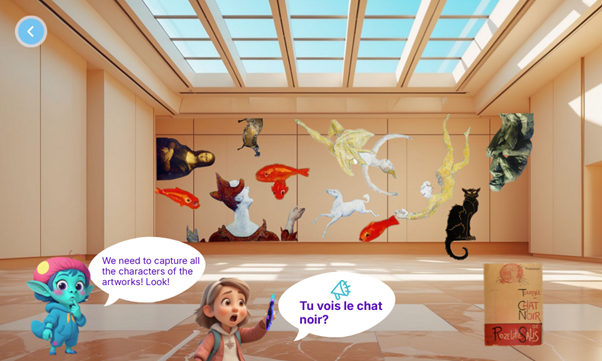
Dans le projet Globetrotters, cela est intégré à la conception des activités numériques. Un enfant peut cliquer pour entendre un mot, le voir dans un contexte et interagir avec lui à travers un jeu. Cela permet aux apprenants de s’appuyer sur leurs points forts. Un apprenant visuel se concentre sur les images, un apprenant plus auditif sur le son, et un apprenant plus kinéthique sur l’interaction du jeu.
La manière dont on demande aux enfants de répondre est tout aussi importante. De nombreux supports traditionnels supposent que l’écriture est la manière par défaut de montrer sa compréhension. Mais l’écriture peut constituer un obstacle pour de nombreux apprenants neurodivergents. Proposer d’autres façons de répondre change complètement l’expérience.
Une activité simple peut être conçue de manière à permettre aux enfants de répondre en cliquant, en sélectionnant, en parlant ou en dessinant. Par exemple, au lieu de demander « Écris la bonne réponse », une tâche peut inviter les enfants à choisir, associer ou mimer la réponse. Cela ne réduit pas les attentes. Cela supprime les obstacles inutiles entre l’apprenant et la tâche.
L’engagement doit également être intégré au support lui-même. Les apprenants neurodivergents rencontrent souvent des difficultés avec les tâches qui semblent abstraites ou déconnectées. Les supports qui incluent des histoires, des personnages ou des contextes de la vie réelle sont plus faciles à s’approprier. Les recherches montrent que lorsque les apprenants se sentent intéressés et émotionnellement impliqués, ils sont plus susceptibles de persévérer et de réussir (Deci & Ryan, 2000).
C’est pourquoi de nombreuses activités Globetrotters sont présentées comme de petites missions ou histoires. Au lieu de compléter un exercice, les enfants aident un personnage, explorent un lieu ou relèvent un défi. L’objectif d’apprentissage reste le même, mais l’expérience devient plus significative.
La structure est un autre élément important, en particulier pour les apprenants qui ont besoin de prévisibilité. Les supports doivent suivre des schémas cohérents. Si chaque activité utilise une mise en page similaire, des icônes similaires et des types d’interaction similaires, les enfants dépensent moins d’énergie à comprendre comment les choses fonctionnent et davantage d’énergie à apprendre.
En même temps, la structure ne doit pas supprimer le choix. Même de petits choix peuvent faire une différence. Permettre à un enfant de décider par quelle activité commencer, quel personnage suivre ou comment répondre augmente son sentiment de contrôle. Cela soutient la motivation et l’engagement, comme le souligne la théorie de l’autodétermination (Deci & Ryan, 2000).
Dans la pratique, concevoir pour la neurodiversité revient souvent à prendre de petites décisions intentionnelles. Utiliser des icônes plutôt que de longues consignes. Fournir de l’audio en complément du texte. Permettre le mouvement ou l’interaction. Garder des mises en page claires et cohérentes. Proposer plus d’une manière de répondre. Aucun de ces changements n’est complexe en soi, mais ensemble, ils transforment l’accessibilité et l’efficacité d’un support d’apprentissage.
Ce qui est intéressant, c’est que ces ajustements ne bénéficient que rarement à un seul groupe d’apprenants. Une mise en page plus claire aide un enfant ayant des difficultés d’attention, mais elle aide aussi un enfant qui est simplement fatigué. Le soutien audio aide un enfant ayant des difficultés de lecture, mais il soutient aussi la prononciation de tous. Les éléments interactifs aident un enfant qui a besoin de bouger, mais ils augmentent aussi l’engagement de l’ensemble du groupe.
Concevoir pour la neurodiversité ne crée pas des parcours séparés. Cela crée de meilleurs parcours. En fin de compte, il ne s’agit pas de concevoir pour des « cas particuliers ». Il s’agit de reconnaître que la variabilité est la norme. Lorsque les supports reflètent cette réalité, ils deviennent plus faciles à utiliser, plus engageants et plus inclusifs dès leur conception.
Références
Deci, E. L., & Ryan, R. M. (2000). The “what” and “why” of goal pursuits: Human needs and the self-determination of behavior. Psychological Inquiry, 11(4), 227–268. https://doi.org/10.1207/S15327965PLI1104_01
Mayer, R. E. (2009). Multimedia learning (2nd ed.). Cambridge University Press. https://doi.org/10.1017/CBO9780511811678
Meyer, A., Rose, D. H., & Gordon, D. (2014). Universal design for learning: Theory and practice. CAST Professional Publishing. http://udltheorypractice.cast.org