
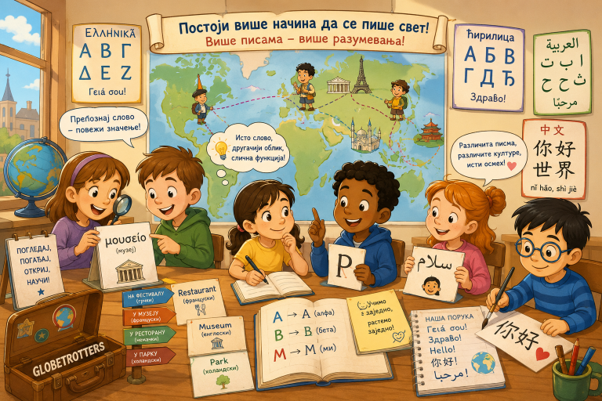
Image created with help of AI
What children learn when they discover other alphabets and scripts
Learning about different alphabets and writing systems is one of the most effective ways to foster children’s curiosity, cognitive flexibility, and appreciation of cultural diversity. When students encounter writing systems that differ from their native script for the first time – such as the Greek alphabet, Arabic script, Chinese characters, Cyrillic, or different variants of the Latin alphabet – they acquire far more than new graphic symbols. They begin to engage with different ways of thinking, communicating, and representing meaning.
Within the Globetrotters project, this process is implemented through carefully designed learning modules that integrate language, culture, and authentic everyday situations. For example, in the At the Festival (Greek) module, students are introduced to the Greek alphabet through simple signs, names, and symbols that they are encouraged to recognize and connect with their meanings. Initially, they “guess” the meaning based on visual clues and contextual information. Through guided activities, they gradually learn how individual letters are pronounced and read. This process closely resembles the natural development of literacy and promotes active, inquiry-based learning.
A similar approach is employed throughout the other modules. In activities involving German or Dutch, students compare words written in the Latin alphabet that may look familiar but differ in pronunciation or meaning. For instance, they recognize similarities among words such as Restaurant, Museum, and Park, while also noticing differences in pronunciation and usage. Such comparisons directly contribute to the development of metalinguistic awareness – the ability to reflect on language as a system (Koda, 2007).
Research on bilingualism and early literacy consistently demonstrates that exposure to different writing systems helps children develop a deeper understanding of how languages function (Bassetti, 2012, Bhalloo & Molnar,2021). This becomes particularly evident in the Globetrotters activities, where students naturally begin to establish connections between letters, sounds, and meanings across languages. For example, after becoming familiar with the Greek alphabet, many students recognize that a letter may have a different visual form while serving a function similar to that of a letter in their native language.
Beyond its cognitive benefits, learning about different writing systems also has significant cultural value. A writing system is not merely a technical means of recording language; it is an important component of cultural identity. Through the narrative of the Globetrotters characters travelling across Europe, students encounter diverse cultural contexts in which writing systems appear in authentic situations – on street signs, in museums, and in restaurants. For example, in the At the Museum (French) module, children read simple labels and exhibit names, linking written language with cultural heritage.
Interactive activities further deepen learning. Students are frequently encouraged to “decode” unfamiliar words, match symbols with their meanings, or create simple messages using a newly introduced script. This instructional approach aligns with research demonstrating that active participation and discovery-based learning significantly enhance both comprehension and long-term retention of knowledge.
Equally important is the reduction of anxiety toward unfamiliar writing systems. Rather than perceiving different scripts as “difficult” or “strange,” students experience them as engaging challenges and enjoyable puzzles. Such positive experiences with linguistic diversity can foster more favorable attitudes toward language learning and multilingualism (Cummins, 2014).
Ultimately, within the Globetrotters project, exploring different alphabets and writing systems goes beyond the acquisition of language skills. It promotes broader competencies such as curiosity, critical thinking, and intercultural awareness. As children recognize that languages can be represented through different writing systems, they also develop an understanding that cultures offer diverse ways of interpreting and experiencing the world – one of the central aims of contemporary education.
References
Koda, K. (2007). Reading and language learning: Crosslinguistic constraints on second language reading development. Language Learning, 57(Suppl. 1), 1–44.
https://www.scribd.com/document/78643591/Koda-2007?utm_source=chatgpt.com
Bhalloo, I., & Molnar, M. (2021). Early Precursors of Literacy Development in Simultaneous Bilinguals: A Systematic Review and Meta-Analysis.
Bassetti, B. (2012). Bilingualism and Writing Systems. In T. K. Bhatia & W. C. Ritchie (Eds.), The Handbook of Bilingualism and Multilingualism (2nd ed., pp. 649–670). Wiley-Blackwell.
https://benebassetti.org/wp-content/uploads/2018/11/bassetti2012hbbilingprepub.pdf
Cummins, J. (2014). To what extent are Canadian second language policies evidence-based? Reflections on the intersections of research and policy. Frontiers in Psychology, 5, 358.
https://www.frontiersin.org/journals/psychology/articles/10.3389/fpsyg.2014.00358/full