
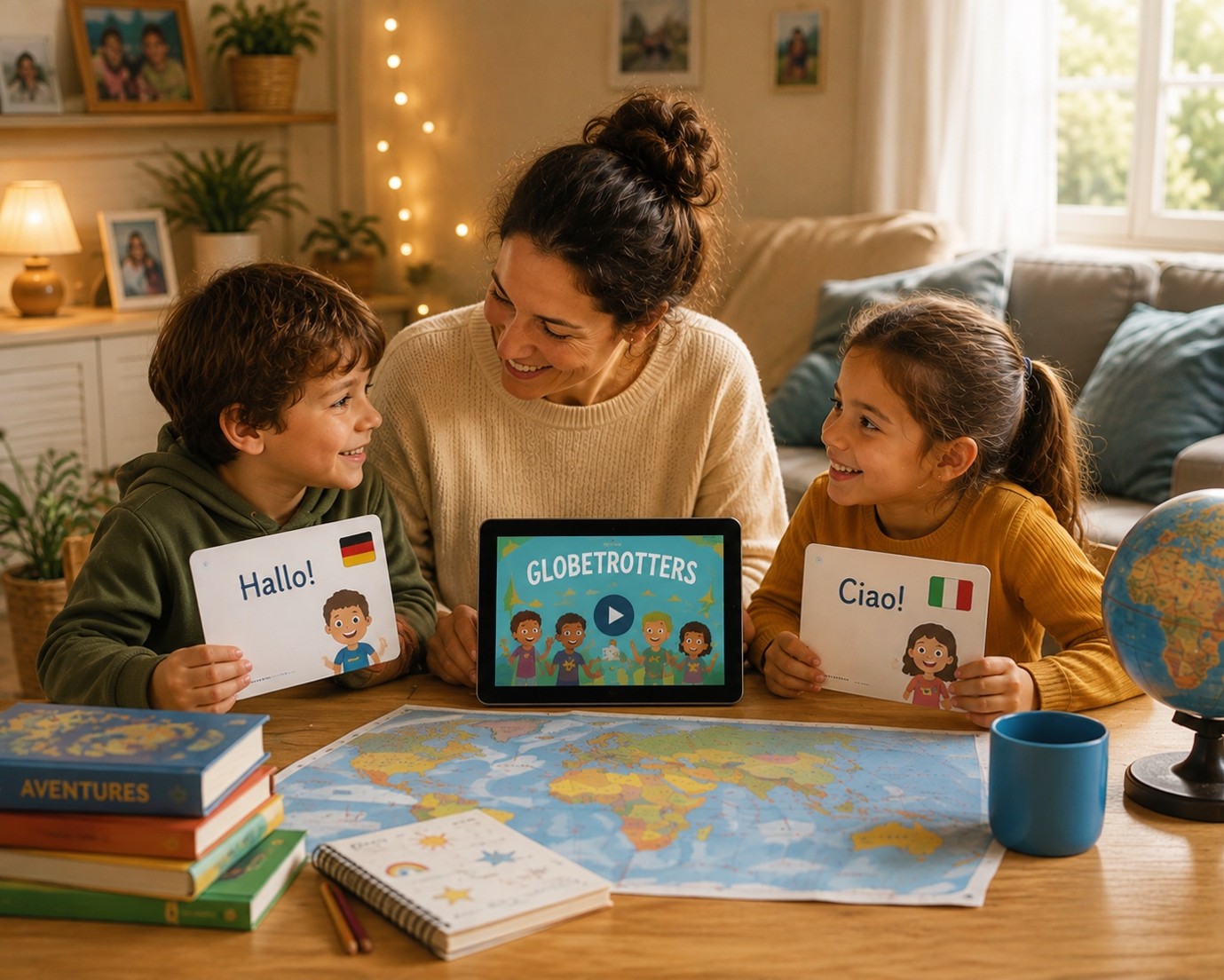
Image created with help of AI
Why you can help your kids learn languages even if you don’t speak all languages
Do you need to make your child repeat a Greek word ten times for it to “stick”? Should every car ride turn into a German vocabulary quiz? Many parents believe that supporting their child’s language learning requires discipline, repetition, almost a training regime. The Globetrotters project proposes the exact opposite: children learn a language best when it’s linked to play, enjoyment, and the freedom to experiment – not to the pressure of performance.
A parent’s role, then, is not that of a private tutor or a progress supervisor. It’s that of a travel companion: someone who creates opportunities, shows curiosity, and gives the child the time and space for the language to become familiar, little by little.
10 Good Practices for Supporting Without Forcing
- Follow your child’s pace and interests rather than imposing a set programme or fixed schedule: a few well-chosen minutes beat a long, resented session.
- Slip language into everyday moments – while cooking, playing, or driving – rather than turning it into a formal “lesson” at home.
- Let your child become the teacher: ask them to teach you the word or song they discovered in class. This role reversal is very empowering for them.
- Favour short, regular, playful moments over long, occasional sessions: five minutes a day beats one hour once a month.
- Celebrate attempts as much as successes: a mispronounced word tried with enthusiasm deserves as much encouragement as a correct one.
- Use Globetrotters activities at home as a family game – a map, an illustrated dictionary, a board game – not as extra homework after school.
- Expose your child to songs, cartoons, or stories in other languages without requiring full understanding: the ear develops well before meaning is complete.
- Show your own curiosity, even if you don’t speak the language: a parent who says “I don’t know, let’s look it up together” gives the child permission to explore without fear of making mistakes.
- Value enjoyment and curiosity over a perfect accent or the number of words remembered: what matters is the wish to keep going, not the performance in the moment.
- Trust the long game: multilingualism builds up over months and years, through small repeated touches, not a few intensive sessions.
10 Pitfalls to Avoid
- Making your child repeat a word over and over until it’s “right”: this insistence turns a moment of discovery into a chore and can discourage the child from speaking up again.
- Turning every outing or every meal into a vocabulary quiz, risking that language becomes linked to constant evaluation rather than shared enjoyment.
- Comparing your child to other children who are “further along” in a language: every child has their own pace, and comparison feeds anxiety more than motivation.
- Thinking you need to master the language yourself to support your child: your role is to create the opportunity, not to give the lesson.
- Minimising or penalising your child’s mistakes, when they are an integral and necessary part of learning a language.
- Imposing Globetrotters activities as extra homework at the end of a school day, when the child is already tired and has little energy left.
- Giving up at the first sign of disinterest instead of simply changing the activity or the moment: being bored with one game doesn’t mean rejecting the language.
- Reducing learning to mini-tests or informal quizzes at home (“tell me how you say…”), which recreate school-like pressure outside of school.
- Neglecting the cultural dimension – festivals, stories, the characters of the Globetrotters journey – in favour of vocabulary alone, when it’s that dimension that gives the language meaning and makes it stick.
- Believing it’s “too late” or that your child “isn’t a natural” because they don’t already speak several languages: curiosity and enjoyment are more than enough to get started, at any age.
The Globetrotters project rests on a simple conviction: children learn languages the way they learn to walk or speak their first language – through experience, trial, error, and play, never through pressure. As a parent, your greatest asset isn’t your level in the language, but your ability to make this journey light, curious, and shared.
References :
Van den Abeele, V. (2021). Apprendre les langues comme ça ? Ça change tout ! – La Méthode Tradanim. Tradanim