
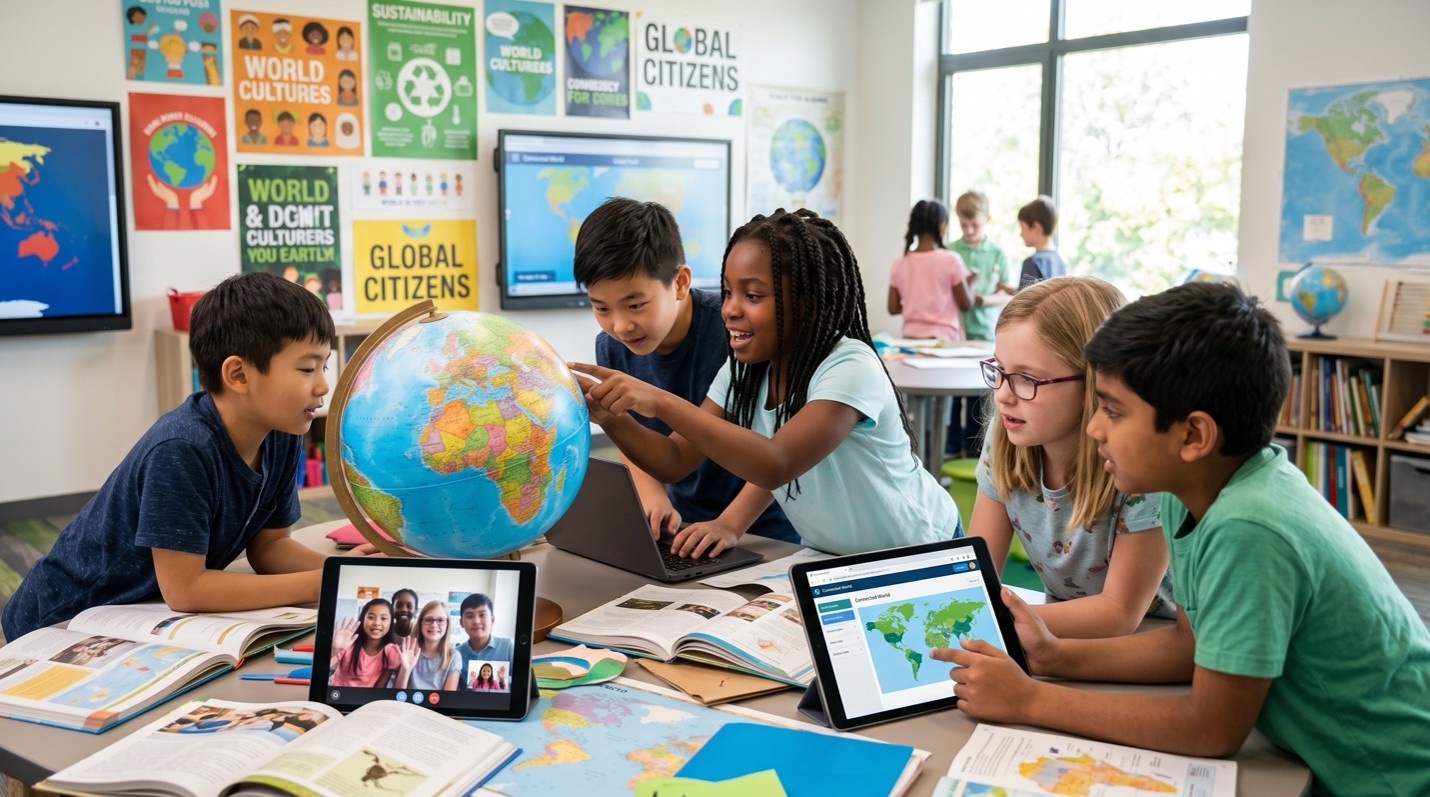
Image created with Gemini
Raising curious citizens: Education for a connected world
Curiosity doesn’t usually make headlines in education debates. We talk about test scores and literacy rates. But the kids who actually thrive – the ones who keep learning long after school ends – are the curious ones. In a world where AI writes essays and jobs change faster than ever, knowing how to ask good questions matters more than memorising answers.
Curiosity is a practice, not a personality trait
Some kids seem naturally inquisitive. But curiosity can be taught, and more importantly, it can be practised.
The Globetrotters project understands this instinctively. It’s an Erasmus+ initiative working with primary schools in Greece, Romania, Serbia, and Belgium, and its whole approach is built on a simple belief: children are natural explorers, born curious and eager to understand the world. The project doesn’t drill facts into kids. Instead, it uses play, storytelling, and gamification to keep that curiosity alive.
Picture this: a group of kids join a journey guided by friendly aliens called the Globbytrotties. Along the way, they explore music from Romania, customs from Greece, words in Dutch and Serbian, and recipes from Belgium. All while solving puzzles and unlocking levels. Learning becomes an adventure. And in that adventure, every culture is celebrated, every language is a key.
That’s how curiosity works. You don’t lecture kids into being interested. You give them something worth exploring.
The global dimension
Curiosity about the world beyond your own street doesn’t come automatically. It has to be cultivated.
UNESCO calls this “global citizenship education.” The idea is simple: we’re connected to people across the planet in ways previous generations couldn’t imagine. Understanding those connections – and caring about them – is now a basic life skill.
Globetrotters builds this in from the start. The project aims to foster intercultural dialogue, promote multilingualism, and enhance cultural awareness among young students. It’s not about adding another subject to the timetable. It’s about how we teach.
And it extends beyond the classroom. The project deliberately involves parents, recognising that learning doesn’t stop at the school door. Curiosity isn’t a school thing. It’s a life thing.
What this looks like in practice
Teachers don’t need to overhaul everything. Small shifts work.
Globetrotters uses what it calls “Language and Culture Discovery Modules” – age-appropriate activities designed for kids aged 6 to 9, built to be engaging, inclusive, and playful. The materials are created with teachers, linguists, digital experts, and cultural organisations across Europe.
The project also emphasizes inclusion at its core. Whether a child is neurodivergent, speaks a different language at home, or learns in non-traditional ways, the tools are designed to be accessible and adaptable. The project partners meet regularly to discuss pedagogical principles, share creative ideas, and refine the materials based on what actually works in classrooms.
The takeaway
Raising curious citizens isn’t about adding another subject. It’s about how we teach, and what we model.
Globetrotters puts it beautifully: children deserve an education that reflects the vast, interconnected world they’re growing into. Not an education that prepares them for tests, but one that prepares them for life together.
The world they’re inheriting will demand curiosity. The least we can do is not squash it.