
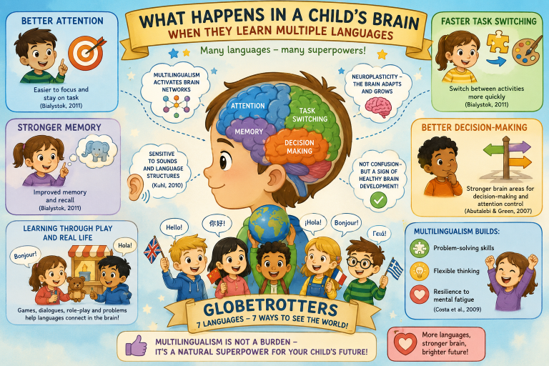
Image created with help of AI
What Happens in a Child’s Brain When They Learn Multiple Languages
Learning
multiple languages during early childhood offers far more than the ability to
communicate in different languages. Neuroscience research shows that
multilingualism influences not only how children speak, but also how they
think, remember, and solve problems.
When
a child learns more than one language, brain networks related to attention,
memory, and behavioral control become activated. In practice, this means that
children can focus their attention more easily, switch between tasks more
quickly, and better manage situations where they need to select between
competing pieces of information (Bialystok, 2011). As children learn and use
more than one language, they strengthen brain networks involved in
decision-making, attention control, and cognitive flexibility (Abutalebi &
Green, 2007). Тhese changes develop gradually through everyday language
experiences, particularly during early childhood, when the brain is especially
receptive to learning.
One
of the key concepts is neuroplasticity – the brain’s ability to change and
adapt through learning. During this period, children are particularly sensitive
to new sounds and language structures, especially when language is experienced
through play, communication, and everyday situations (Kuhl, 2010).
The
Globetrotters project reflects these principles by introducing languages
through activities that are meaningful and enjoyable for children, including
games, dialogues, role-play, and problem-solving tasks. Instead of memorizing
language rules, children use languages in real and meaningful contexts. This
helps languages become more connected in the brain and easier to remember. In
addition, children aged 6 to 10 are regularly exposed to authentic
pronunciation in seven different languages through the project
modules.Listening to and repeating authentic speech in different languages
strengthens children’s phonological awareness by helping them recognise and
distinguish unfamiliar sounds more effectively. Over time, this supports
clearer pronunciation and makes them more confident and adaptable language
learners.
Beyond
language learning itself, multilingual experience has been associated with
stronger problem-solving skills, greater cognitive flexibility, and increased
resistance to mental fatigue (Costa et al., 2009). A common misconception is
that learning several languages confuses children. Evidence suggests the
opposite: young learners are able to separate their languages and switch
between them according to the situation, demonstrating healthy cognitive
development rather than confusion.
For
this reason, multilingual activities within projects such as Globetrotters
support much more than language development. The project’s guides for teachers
and parents encourage adults to explore new languages together with children
through playful and meaningful activities, creating a supportive environment
that strengthens both language learning and cognitive development.
References
Abutalebi,
J., & Green, D. W. (2007). Bilingual language production: The
neurocognition of language representation and control. Journal of
Neurolinguistics.
https://doi.org/10.1016/j.jneuroling.2006.10.003
Bialystok,
E. (2011). Coordination of executive functions in multilingual children. Cognition.
https://doi.org/10.1016/j.cognition.2010.10.014
Costa,
A., Hernández, M., & Sebastián-Gallés, N. (2009). Bilingualism aids
conflict resolution: Evidence from the ANT task. Cognition. https://www.sciencedirect.com/science/article/abs/pii/S001002770600268X
Kuhl,
P. K. (2010). Brain mechanisms in early language acquisition. Neuron. https://www.sciencedirect.com/science/article/pii/S0896627310006811